Njelama Sanga, PhD
Polymer & Colloid Chemist
Research interests
My research focuses on PFAS, colloid and interface science, and water treatment, with a particular interest in translating physicochemical insights into practical remediation technologies. I am seeking postdoctoral and research or industry opportunities in PFAS remediation, analytical and physical chemistry, soft matter, and environmental treatment, with a long-term goal of developing an independent research programme in Zambia that connects fundamental chemistry with environmental remediation and scientific capacity building. My work also has relevance to industrial water-treatment challenges involving scale control, corrosion-related water chemistry, cooling-water systems, and the optimisation of separation and monitoring processes.
Research highlight
My doctoral research combined PFAS surfactant self-assembly, SANS/SAXS and neutron reflectometry to understand structure, hydration and interfacial interactions. This provides a foundation for developing and evaluating adsorption-based remediation concepts, including functionalised silica and natural materials, with attention to selectivity, reversibility and practical water-treatment requirements.
What I bring
- Experimental design, optimisation and troubleshooting at large-scale research facilities.
- Quantitative scattering analysis and modelling using SasView.
- Water-sample concentration and analytical workflows from MSc research.
- Multidisciplinary collaboration, technical reporting and scientific communication.
Doctoral Thesis
Self-assembly of fluorocarbon amphiphiles and their interactions at interfaces with a seed protein
Sanga, N. (2025). Self-assembly of fluorocarbon amphiphiles and their interactions at interfaces with a seed protein. Doctoral thesis, comprehensive summary. Uppsala: Acta Universitatis Upsaliensis. Digital Comprehensive Summaries of Uppsala Dissertations from the Faculty of Science and Technology, 2607.
Doctoral research on the physicochemical properties, self-assembly, hydration and interactions of perfluorooctanoate-based PFAS surfactants, using small-angle X-ray/neutron scattering and neutron reflection, including interactions with Moringa oleifera seed protein.
View thesis on Uppsala DiVAResearch Facilities & Neutron Training
Rutherford Appleton Laboratory (RAL), UK
Neutron-scattering research at the Rutherford Appleton Laboratory, supporting structural and interfacial studies of soft-matter and surfactant systems.
Institut Laue-Langevin (ILL), Grenoble, France
Neutron-scattering research at the ILL in Grenoble, supporting studies of surfactant self-assembly, structure and interfacial interactions.
Neutron Scattering School, Delft, Netherlands
Specialised training in neutron-scattering methods, instrumentation, experimental planning, data analysis and interpretation.
Neutron School, J-PARC, Japan
Specialised training in neutron techniques, instrumentation, experimental planning and data analysis.
Uppsala University research laboratories
Soft-matter, colloid and interface research, including sample preparation, experimental design and data analysis.
Ural Federal University research laboratories
Reverse-osmosis/baromembrane filtration, water-sample concentration and isotope-focused analytical work.
Completed Projects
MSc Research — Verification of a Baromembrane Method for Concentrating Water Samples
Ural Federal University (2019–2021)
Completed MSc research investigating a reverse-osmosis baromembrane method for concentrating water samples containing manganese, cobalt, strontium and caesium. The study evaluated concentration behaviour across repeated membrane cycles and assessed the potential to improve the sensitivity of radiometric, radiochemical and spectrometric measurements of radioactive isotopes.
Outcome: The baromembrane method demonstrated the ability to concentrate the investigated elements and reduce sample volume by up to 20-fold, supporting subsequent radiometric or spectrometric analysis.
Methods & skills:
Reverse osmosis and baromembrane filtrationWater sample preparation and concentrationStable and radioactive isotope handlingMass spectrometryConductivity measurementsConcentration and demineralisation coefficient calculationsExperimental optimisation and troubleshootingRadiometric, radiochemical and spectrometric method development
Industrial Water Treatment & Production Internship
Zambia Breweries (Feb 2012 – May 2012)
Completed an industrial placement supporting water-treatment and production operations, with practical exposure to process monitoring, laboratory quality checks and routine testing of water and production-related samples.
Outcome: Gained early industrial experience in a production environment, connecting laboratory measurements with routine process monitoring and quality requirements.
Methods & skills:
Water treatment process monitoringLaboratory quality checks and testingSample handling and preparationProcess-oriented troubleshooting
Publications
Sanga, N.; Ahrens, L.; Rennie, A. R. Counterion influence on perfluorooctanoate micelle characteristics: Shape, size, and interactions. Colloids and Surfaces A: Physicochemical and Engineering Aspects 2025, 726, 137912.
DOI / Article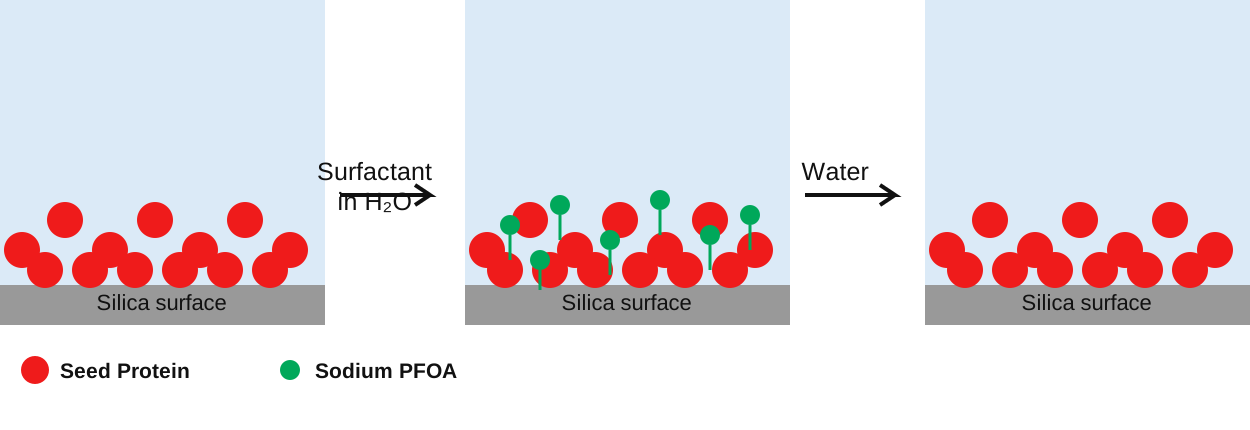
Sanga, N.; Croy, N.; Ahrens, L.; Welbourn, R. J. L.; Rennie, A. R. Interaction of Perfluorooctanoate and Perfluorohexanoate with Moringa oleifera Seed Protein. Langmuir 2025, 41(25), 16500–16505.
DOI / ArticleSanga, N.; Ahrens, L.; Smith, G. N.; Rennie, A. R. Influence of magnesium on the structure and hydration of perfluorooctanoate micelles – comparison with sodium salt. RSC Advances 2026.
DOI / ArticleAzmi, N.; Akanno, A.; Demchenko, H.; Sanga, N.; Fossum, J. O. Comparative Analysis and Characterization of Various Extraction Techniques of Food-Grade Particles From Moringa oleifera Lam. Seeds. European Journal of Lipid Science and Technology 2025, 127(12), e70071.
DOI / ArticleCareer
PhD Researcher, Polymer & Colloid Chemistry
Oct 2021 – Oct 2025
Uppsala University (Sweden)
Designed and executed a 4-year experimental research programme on PFAS surfactant self-assembly and aggregation in aqueous systems, evaluating the effects of counterions, concentration, and temperature on micellar structure and interactions.
Selected accomplishments:- Investigated interfacial interactions between fluorinated surfactants and Moringa oleifera seed protein systems using neutron reflectometry.
- Planned and coordinated 8+ experimental campaigns at international neutron scattering facilities, collaborating with multidisciplinary research teams across multiple countries.
- Performed experimental troubleshooting, uncertainty evaluation, and optimisation of measurement conditions, reducing sample preparation time by approximately 40% through workflow redesign.
- Interpreted complex experimental datasets and translated findings into scientific conclusions, technical reports, peer-reviewed publications, and conference presentations.
Staff Development Fellow, Department of Chemistry
Jul 2017 – Present
University of Zambia (Zambia)
On leave for doctoral studies during 2021–2025; undergraduate teaching and academic capacity development.
Selected accomplishments:- Delivered laboratory demonstrations and tutorials in Physical Chemistry and first-year general chemistry to undergraduate cohorts of 120+ students.
- Designed and implemented two new practical chemistry modules, including experimental procedures and safety documentation.
- Assessed assignments, tests, and examinations, and supported students in scientific problem-solving and technical report writing.
- Selected for a competitive academic staff development pathway supporting future research and teaching capacity within the department.
Technical Skills
Instrumentation & Modelling
- SasView / quantitative modelling
- Data analysis
Experimental & Analytical Methods
- SANS / SAXS
- Neutron reflectometry
Core Competencies
- Colloid and interface science
- PFAS chemistry and surfactant self-assembly
- Experimental design, optimisation and troubleshooting
- Scientific writing, technical reporting and presentations
- Quantitative data analysis and interpretation
- Undergraduate teaching and student supervision
Education
Languages
Podcast
Featured podcast episode
I recently took part in a podcast conversation sharing my experiences and perspectives as a scientist. Listen to the episode on Spotify.
Listen on Spotify